
Understanding Student Writing Processes in the Age of GenAI
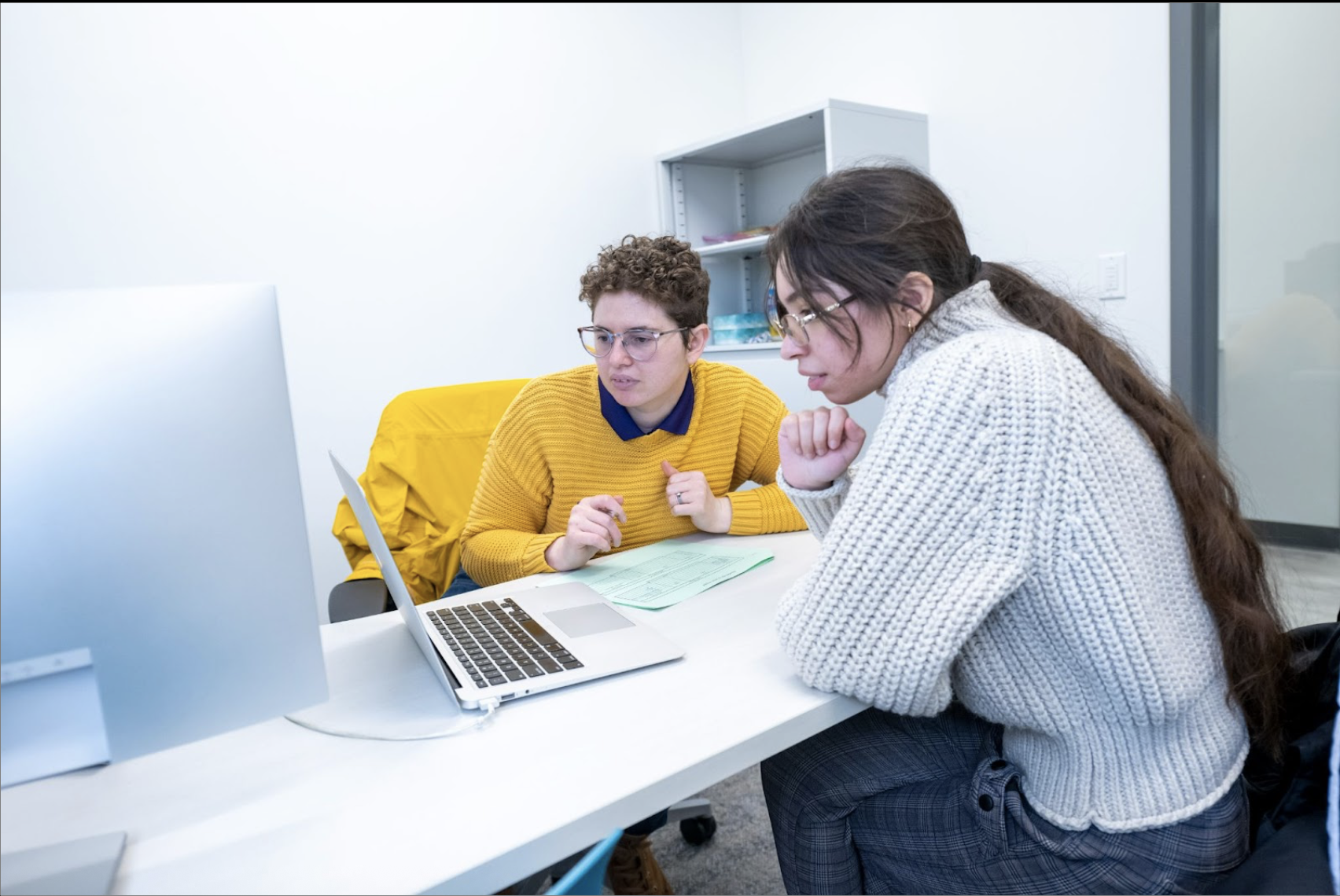
CEETL was awarded a grant to study students' writing processes with genAI. The study is entitled: Investigating How Students Write With GenAI: Co-Creating Innovative Curricular Materials for Writing Courses
Learn More About the Study
Contact the Research Team: Dr. Anoshua Chaudhuri, Dr. Jennifer Trainor, Dr. Aviva Sinervo and Dr. Tara Lockhart

Investigating How Students Write With GenAI: Co-Creating Innovative Curricular Materials for Writing Courses
In this research project, we are investigating how students use GenAi in their writing process.
The study focuses on both lower-division and Graduate Writing Assessment Requirement (GWAR) courses. The grant will fund faculty learning communities who will discuss research findings and co-create teaching materials that address changing students’ writing processes and needs.
This study is led by Principal Investigator Dr. Jennifer Trainor and co-Principal Investigator Dr. Anoshua Chaudhuri.
Jennifer Trainor is a professor of English, a faculty director at CEETL, and the Director of First-Year Writing at SF State. She has written a book and several articles on the teaching of writing, including equitable and anti-racist approaches to literacy education. Anoshua Chaudhuri is the Director of CEETL and a professor of Economics. She has over 25 publications in peer-reviewed journals and books. She collaborates with community agencies in participatory research projects and has received many engaged scholarship awards and high-impact teaching awards as she involves her students in these research projects.
In the Fall semester of 2025, Jennifer Trainor and Aviva Sinervo led a pilot study of what kind of assignments could work in the classroom with or without AI. They collected student reflections, talked to students in focus groups and used the information to build sample writing assignments that could work for the Spring 2026 CEETL AI Fellows.
Aviva Sinervo is a lecturer faculty in Psychology who routinely teaches GWAR courses, has been a faculty contributor to CEETL's Teaching Writing course and will continue to be a CEETL AI Fellow on this project.
Understanding AI Usage
Discover how students are currently using AI tools in their writing processes and how students use AI outputs to facilitate their thinking and rhetorical work.
Addressing Concerns
Investigate whether AI outputs "override" students' thinking, as many educators have worried, and identify classroom strategies that may remove or lessen learning loss due to AI.
Generating New Insights
Develop new understandings of how AI is changing students' writing process to inform curriculum development and teaching practices.
We are delighted to announce the CEETL AI Fellows who will participate in a faculty learning community to study students' writing process with GenAI.
Amy Latham, Lecturer Faculty in Business Communication
Aviva Sinervo, Lecturer Faculty in Psychology
Brian Strang, Lecturer Faculty in English
Kimbrough Moore, Lecturer Faculty in Philosophy & Computer Science
Laura Moorhead, Associate Professor of Journalism
Niny Arcila-Maya, Assistant Professor of Mathematics
Shubhi Sachdeva, Assistant Professor of Child & Adolescent Development
Tara Lockhart, Professor of English
Yuki Obayashi, Lecturer Faculty in Asian American Studies
& Jennifer Trainor, Professor of English (also PI of the project)
We began our project with a desire to complicate binary thinking about student writers’ use of AI. We believed that the question of whether students “used” AI to write or not was too blunt, obscuring a potentially more nuanced picture of different kinds of student writers' use at various stages of a multi-stage writing process. Without an understanding of these nuances, writing faculty would naturally remain in the prohibition camp, even as AI became more and more normalized as one tool among many that student writers employ.
Over the course of the grant year, working with instructors across the vertical writing curriculum on our campus and across disciplines, we learned that indeed students perceive and use AI differently depending on writing process stage. But we also learned that these nuanced differences extend beyond stages of the writing process; students’ AI use varies by their level of academic writing development; it changes across assignment genre, discipline, and course context; and it is dependent on variations in affective engagement with AI. These multiple axes of influence on student writers’ AI use mean that instructors will need to design careful and nuanced AI approaches for each assignment in their course, and will need to develop targeted custom AI tools for students. Instructors will need to work with students in analyzing outputs and teach prompting strategies that are keyed to stages of the writing process, sensitive to students’ developmental level and rhetorical abilities, and aligned with disciplinary and genre norms. Finally, instructors will need to redesign courses so that targeted prohibition, and exemptions for students’ ethical refusal. both of which students are asking for, can be realized.
Other complicating factors that surfaced in our project:
1) AI use in the writing process involves tradeoffs that don’t necessarily save time or improve students’ writing development. The tradeoffs involve rhetorical but also affective labor on the part of students, with implications for students' confidence, learning, equity, and linguistic justice.
2) Students’ ability to use AI ethically and in human-in-charge ways develops in parallel with their non-AI writing abilities. Students who learn to develop their rhetorical purpose or refine their own research questions transfer those skills to human-in-charge prompting. Students who practice working with feedback transfer that learning to working with AI outputs. Pre-AI-era writing skills and strategies, ironically, remain crucial to help students develop human-in-charge AI skills.
3) A nuanced understanding of how students use AI throughout the writing process has implications for addressing equity gaps. Many teachers on our campus have suggested that multilingual writers and students with education debt (Ladson Billings 2006) may struggle to manipulate AI outputs and may outsource their writing more fully to AI tools, whereas students with a firmer grounding in standard academic English remain in more rhetorical control of AI outputs. Understanding how AI use in the writing process addresses or exacerbates existing literacy gaps is crucial. Such understandings are vital for teachers as it will help them redesign instruction to promote responsible and equitable AI use.
The Importance of the Writing Process
At SF State, writing instruction at all levels includes Student Learning Outcomes that emphasize the writing process, defined as the recursive steps writers go through as they brainstorm, draft, and revise.
This approach is consistent with national recommendations and research, making the writing process a cornerstone of the curriculum in both lower-division General Education and Graduate Writing Assessment Requirement courses.
At SF State we teach both procedural knowledge about how to engage in a multistep writing process at all levels, and provide support for students as they practice these steps. This approach is supported by scholarship and national best practices.
Current Challenges
Research shows that novice writers often use a truncated, ineffective writing process, leading them to miss opportunities for critical and rhetorical thinking and analysis (Flower and Hayes).
Many faculty are concerned that GenAI tools may exacerbate this problem, offering students an even faster route to a final draft, and hence threatening opportunities for students to think critically about topics and engage in rhetorical decision-making.
These concerns have led many faculty to prohibit and police students' GenAI use in writing courses or writing assignments, creating a disconnect between classroom policies and real-world writing practices.
Brainstorming
Students report using AI "to get ideas" or for brainstorming, helping them initiate the writing process.
Catalyzing Writing
AI outputs "boost" or catalyze writing, providing new sentence structures or vocabulary that serve as models to imitate and build upon.
Revision Support
Students use AI tools to develop ideas, put thoughts into words, and revise, getting support for editing and formatting into appropriate genres.
Research suggests that a growing number of students already view "AI as normal technology" and understand that in the future, "a greater and greater proportion of what people do in their jobs is AI control" (Narayanan and Kapoor, 2025).
GenAI is now embedded into most reading and writing spaces that students encounter.
Helping faculty understand how GenAI is changing the writing process for students, and how to teach all students to use GenAI as a tool in the writing process, is critical.
This research will help bridge the gap between current teaching practices and the evolving landscape of writing in a world where AI tools are increasingly integrated into everyday communication.

Join the Conversation
The findings from this study will help CEETL make recommendations to campus AI literacy content developers in the tutoring center (TASC), library, and academic technology (AT).
Co-created artifacts will be discussed in workshops and communities of practice to help teachers redesign their curriculum for the AI era, ensuring students develop critical writing skills while leveraging new technologies.
Together, we can develop writing classrooms that embrace technological change while preserving the critical and rhetorical thinking that is at the heart of writing.
Co-Creating the Curriculum; Faculty Communities of Practice
Abeywickrama, Priyavanda, et al. "Charting a New Course: Organic Writing Program Assessment in Action." Perspectives on Good Writing in Applied Linguistics and TESOL (2023): 75.
Bovill, Catherine. "Students and staff co-creating curriculum in higher education." International encyclopedia of education. Elsevier, 2022. 235-244.
Bovill, Catherine, Joy Jarvis, and Karen Mpamhanga. Co-creating learning and teaching: Towards relational pedagogy in higher education. Routledge, 2025.
Cook-Sather, Alison, and Jia Yi Loh. "Embracing student agentic engagement and enacting equity in higher education through co-creating learning and teaching." Advancing Student Engagement in Higher Education. Routledge, 2023. 165-178.
Godbold, Nattalia, Tsai-Yu Hung, and Kelly E. Matthews. "Exploring the role of conflict in co-creation of curriculum through engaging students as partners in the classroom." Higher Education Research & Development 41.4 (2022): 1104-1118.
Nasri, Nurfarahin, Nurfaradilla Mohamad Nasri, and Mohamad Asyraf Abd Talib. "Developing an inclusive curriculum: Understanding co-creation through cultural lens." International Journal of Inclusive Education 27.9 (2023): 1072-1083.
Trainor, Jennifer, et al. "Decolonizing Assessment to Reveal Abundance: Crafting Threshold Concepts and Mapping Learning Journeys." CCCC CONVENTION COMPANION PUBLICATION.
Trainor, Jennifer, and John Holland. Personal, Accessible, Responsive, and Strategic Assessment: Creating a Faculty Community of Practice, DOI: 10.37514/PRA-B.2023.1985.2.10
Tsui, Eric, et al. "Co-creating curriculum with students, teachers, and practitioners in a technology-enhanced environment." Educational technology research and development 72.2 (2024): 869-893.
The Writing Process
Applebee, Arthur N., et al. "Taking the long view on writing development." Research in the Teaching of English 51.3 (2017): 351-360.
Baker, Kimberly M. "Peer review as a strategy for improving students’ writing process." Active Learning in Higher Education 17.3 (2016): 179-192.
Barrett, Alex, and Austin Pack. "Not quite eye to AI: Student and teacher perspectives on the use of generative artificial intelligence in the writing process." International Journal of Educational Technology in Higher Education 20.1 (2023): 59.
Beck, Sarah W., and Sarah R. Levine. "Backtalk: ChatGPT: A powerful technology tool for writing instruction." Phi Delta Kappan 105.1 (2023): 66-67.
Chaudhuri, Anoshua, and Jennifer Trainor. “Three Laws for Curriculum Design in an AI Age.” Inside Higher Ed (April 2025).
Chaudhuri, A. Jessica Adams-Grigorieff, Jennifer Trainor, and Andrew Roderick. Sense-making Through Community: Building AI Guidance for Teaching and Learning,” CSU 2024 Symposium on Teaching and Learning, February, 2024, Cal State San Bernardino
Clayson, Ashley. "Distributed cognition and embodiment in text planning: A situated study of collaborative writing in the workplace." Written Communication 35.2 (2018): 155-181.
Elbow, Peter. Writing with power: Techniques for mastering the writing process. Oxford University Press, 1998.
Evans, Katherine, and Dana Ferris. "Revision from multiple feedback sources: The attitudes and behaviors of three multilingual student writers." Research in the Teaching of English 54.2 (2019): 131-160.
Evmenova, Anya S., and Kelley Regan. "Supporting the writing process with technology for students with disabilities." Intervention in School and Clinic 55.2 (2019): 78-85.
Flower, Linda S., and John R. Hayes. "Problem-solving strategies and the writing process." College English 39.4 (1977): 449-461.
Gallagher, John R., Kyle Wagner, and Jordan Canzonetta. "When collaborating turns into dishonesty: A data-driven heuristic comparing human and AI collaborators." Computers and Composition 77 (2025): 102947.
Göldi, Andreas, et al. "Intelligent support engages writers through relevant cognitive processes." Proceedings of the 2024 CHI Conference on Human Factors in Computing Systems. 2024.
Haas, Christina. "How the writing medium shapes the writing process: Effects of word processing on planning." Research in the Teaching of English 23.2 (1989): 181-207.
Hart-Davison, Bill. MSU Interview. 2023
Hayes, John R., and Linda S. Flower. "On the structure of the writing process." Topics in language disorders 7.4 (1987): 19-30.
Huijboom, Fred, et al. "Professional learning communities (PLCs) as learning environments for teachers: An in-depth examination of the development of seven PLCs and influencing factors." Learning, Culture and Social Interaction 31 (2021): 100566.
Jakesch, Maurice, et al. "Co-writing with opinionated language models affects users’ views." Proceedings of the 2023 CHI conference on human factors in computing systems. 2023.
Kim, Jinhee, et al. "Exploring students’ perspectives on generative AI-assisted academic writing." Education and Information Technologies 30.1 (2025): 1265-1300.
Kramer, Tereza Joy, et al. "WID course enhancements in STEM: The impact of adding ‘writing circles’ and writing process pedagogy." Across the Disciplines 16.4 (2019): 26.
Knowles, Alan M. "Machine-in-the-loop writing: Optimizing the rhetorical load." Computers and Composition 71 (2024): 102826.
Ladson-Billings, Gloria. "From the achievement gap to the education debt: Understanding achievement in US schools." Educational researcher 35.7 (2006): 3-12.
Levine, Sarah, et al. "How do students use ChatGPT as a writing support?." Journal of Adolescent & Adult Literacy 68.5 (2025): 445-457.
Liu, Meilu, Lawrence Jun Zhang, and Christine Biebricher. "Investigating students’ cognitive processes in generative AI-assisted digital multimodal composing and traditional writing." Computers & Education 211 (2024): 104977.
Manierre, Matt, et al. "Coexisting with ChatGPT: Evaluating a tool for AI-based paper revision." Computers and Composition 76 (2025): 102923.
McCutchen, Deborah, Paul Teske, and Catherine Bankston. "Writing and cognition: Implications of the cognitive architecture for learning to write and writing to learn." Handbook of research on writing. Routledge, 2009. 554-578.
Narayanan, A., and Kapoor, Sayeesh. AI As Normal Technology
Odell, Lee. "The process of writing and the process of learning." College Composition &
Communication 31.1 (1980): 42-50.
Reither, James A. "Writing and knowing: Toward redefining the writing process." College English 47.6 (1985): 620-628.
Van den Bergh, Huub, and Gert Rijlaarsdam. "The dynamics of composing: Modeling writing process data." The science of writing. Routledge, 2013. 207-232.
Vandermeulen, Nina, Mariëlle Leijten, and Luuk Van Waes. "Reporting writing process feedback in the classroom using keystroke logging data to reflect on writing processes." Journal of Writing Research 12.1 (2020): 109-139.
Warnock, John. "The writing process." Rhetoric Review 2.1 (1983): 4-27.
Winsor, Dorothy A. "Learning to do knowledge work in systems of distributed cognition." Journal of business and technical communication 15.1 (2001): 5-28.
Zhai, Chunpeng, Santoso Wibowo, and Lily D. Li. "The effects of over-reliance on AI dialogue systems on students' cognitive abilities: a systematic review." Smart Learning Environments 11.1 (2024): 28.
Zhang, Zhe Victor. "Engaging with automated writing evaluation (AWE) feedback on L2 writing: Student perceptions and revisions." Assessing Writing 43 (2020): 100439.
Zhao, Xin, Jiahong Xu, and Andrew Cox. "Incorporating artificial intelligence into student academic writing in higher education: The use of Wordtune by Chinese international students." (2024).